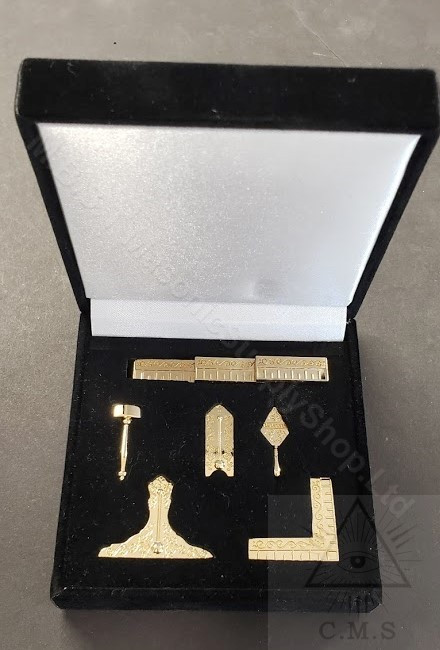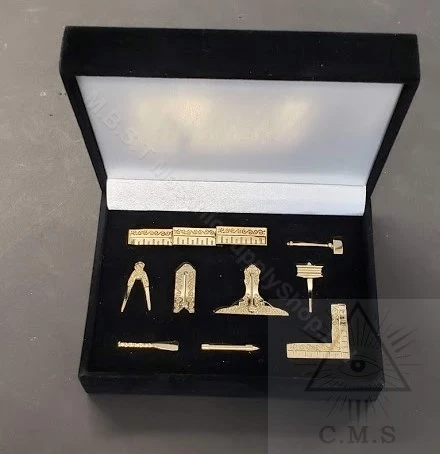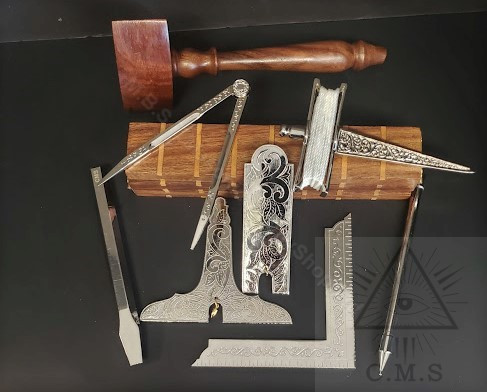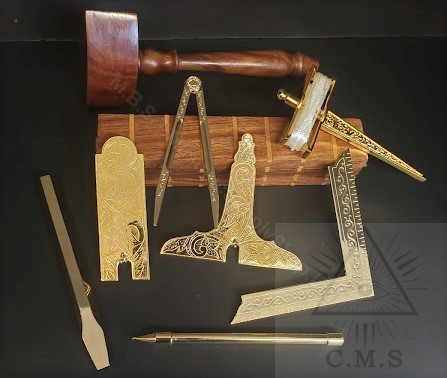
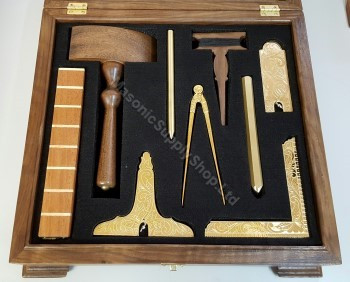
Freemasonry takes the tools of the operative stonemason and gives each one a moral lesson. The full explanations are given to candidates in the lodge, but the tools themselves and their operative uses are well known. Here is an overview.
Tools commonly presented in the first degree
- The twenty-four-inch gauge: a measuring rule used by operative masons to measure and lay out work.
- The common gavel: used to knock off the rough corners of stones.
- The chisel (in some workings): used with the gavel to shape and smooth stone.
Tools commonly presented in the second degree
- The square: used to test that angles are true.
- The level: used to check that horizontal surfaces are even.
- The plumb: used to check that walls are vertical.
Tools commonly presented in the third degree
- The skirret: a cord on a central pin, used to mark out a building's foundation.
- The pencil: used to draw plans.
- The compasses: used to describe circles and measure proportions.
- The trowel (in many American workings): used to spread mortar.
Exactly which tools belong to each degree depends on the working your lodge uses.
From operative to speculative
Operative masons built cathedrals and castles with these tools. Speculative Freemasons use them symbolically, as reminders of how to shape character and conduct. The lessons are best heard in the lodge, where they are given in full.
Working tools as gifts and décor
Miniature sets of working tools, often framed or cased, are popular gifts for new Master Masons and Past Masters, and look handsome in a study or office.
Caring for working tools
Wipe metal tools after use, store them in a fitted case, and keep them dry to prevent tarnish.
Learning more
Your lodge's ritual, lectures and education officer are the best guides to the full meaning of each tool. Many Grand Lodges also publish education materials for newer Masons that discuss the working tools in more depth.
Tools in concordant bodies
Other Masonic bodies use their own symbolic tools. The Royal Arch, for example, has tools associated with its own degree, and the meanings are explained to Companions in the Chapter.
Working tools in Masonic art
The working tools appear on aprons, tracing boards, certificates and jewels across Masonic history.
Lodge education
Ask your lodge's education officer about evenings exploring the working tools in more depth.
See working tools at the Canadian Masonic Supply Shop, or return to our Masonic shop guide to working tools.